Relationship & enquiry
Client log, sales enquiries, customers, suppliers, business partners, notes, tasks and credit context.


AL CHISHTY Engineering Work is the first reference implementation of Kordivon Forge—a live ERP and operations platform developed around the commercial, workshop, purchasing, financial, workforce and document realities of an engineering business.
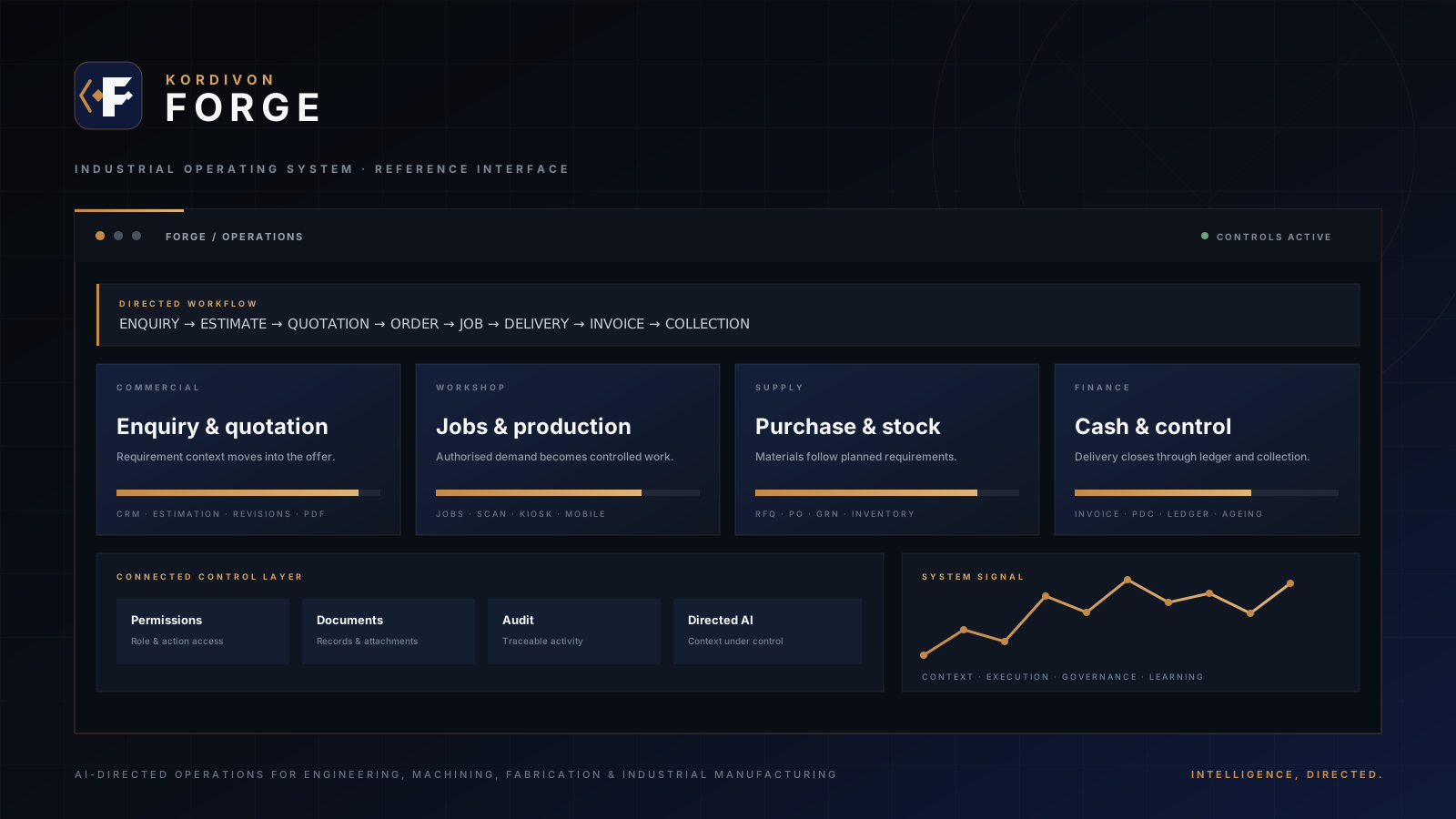
A single engineering job can begin as a phone call or drawing, move through estimation and quotation, require material buying and workshop capacity, generate delivery and invoicing obligations, and remain commercially incomplete until payment clears. The system needed to preserve that context across every handoff.
The reference implementation spans the functional domains required to take industrial demand from first contact through workshop execution, financial control and management visibility.
Client log, sales enquiries, customers, suppliers, business partners, notes, tasks and credit context.
Estimation, quotation revisions, attachments, sales orders, delivery notes, invoices and credit notes.
Production jobs, live workshop records, job scanning, operator access and mobile production capture.
Purchase flows, RFQ and order control, GRN / MRN, purchase vouchers, stock movement and remnants.
Chart of accounts, vouchers, ledgers, receipts, PDC lifecycle, payments, ageing, reconciliation and reporting.
Employee records, attendance devices, shifts, leave, payroll, WPS, settlements and expiring documents.
Structured records, policies, packs, storage, email dispatch, controlled files and operational history.
AI center, expense capture, bank-reconciliation assistance, vision services, permissions, audit and security controls.
Forge is structured so each operational document can inherit or reference the authorised information that came before it, reducing isolated re-entry and preserving the reason behind the transaction.
Forge has been developed with explicit safeguards around financial posting, voucher numbering, data access, permissions and security. New capability is added without treating the production database as disposable.
The reference implementation has grown module by module around real priorities. That approach lets the operating team absorb change while the platform gains depth.
Customer records, enquiries, quotations, sales orders, delivery, invoices and finance records established the transaction chain.
Production, purchasing, inventory, attendance and payroll extended the system from office documents into daily operations.
Permissions, security, document management, storage, reporting and audit strengthened governance around the growing platform.
AI settings, usage, document workflows, expense scanning, reconciliation assistance and visual services began adding controlled intelligence.
The most important outcome is not a dashboard screenshot. It is a connected system that can continue absorbing real business requirements without losing the controls already established.
Commercial, production, supply and financial records can be understood as parts of the same operating chain.
Templates, revisions, attachments, print outputs and records follow defined business processes.
Users receive the modules and actions relevant to their responsibilities instead of universal access.
New workflow, mobile, document, device and AI capability can be added through modular services.
The live implementation provides the operational foundation from which Kordivon Forge can be configured for other industrial companies.
Future implementations can establish baselines for quotation time, job visibility, stock accuracy, collection and administrative effort.
The system combines a modular Python application, relational data, responsive interfaces and specialised services for finance, DMS, AI and security.
We will examine the process, define the first controlled implementation stage and show how Forge can connect the record from enquiry through execution and cash.